“He stepped down, avoiding any long look at her as one avoids long looks at the sun, but seeing her as one sees the sun, without looking.” ― Leo Tolstoy, Anna Karenina
It occurred to me just how much American culture has undergone a sort of “grayification,” “squarification,” and “boxification,” which has inevitably led to a “dullification.” Everything is boring now, because it has been purposefully curated to be safe and sellable.
Architecture has simplified into smooth, clean lines, asphalt color schemes, and perfect straightness; fashion has been uprooted to put bedtime comfort over expression and rebellion; music recycles beats and rhythms; and books and movies recycle tropes and plots.

AI has exacerbated this “dullification” by spewing out recycled copies of recycled copies. Something in me broke; the dullness has reached such epic proportions; I nearly forgot how to admire things. The sentiment truly hit home when some students of mine struggled to write a short response on the universal theme of perseverance in the novel we had just read. Many had lost the ability to admire things as well; even people who had survived military conflicts, starvation, and disease ceased to be interesting as my students looked at their trials and tribulations as fantasy. “Dullification” has not only infiltrated art; it has infiltrated human thought and human connection.
The question is, how do we gain the ability to admire again?
I looked to something simple yet effective: Folk Art.
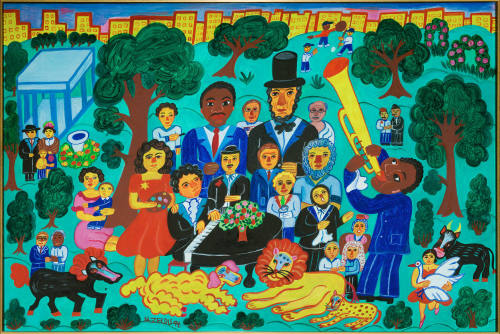
Date: 1994
Artist Malcah Zeldis (b. 1931)
It has already been established by many young people and artists that human connection is the missing ingredient in alleviating the dullness in our lives. We can take the alleviation a step further by revisiting something that appears to be diminishing in our post-modern world: folk art.
Merriam-Webster defines Folk Art as: the traditional decorative or utilitarian art of the people that is often an expression of community life and is distinguished from academic or self-conscious or cosmopolitan expression.
In simpler terms, folk art is any traditional form of art, including painting, music, food, stories, etcetera that have a utilitarian purpose as well as an artistic one.
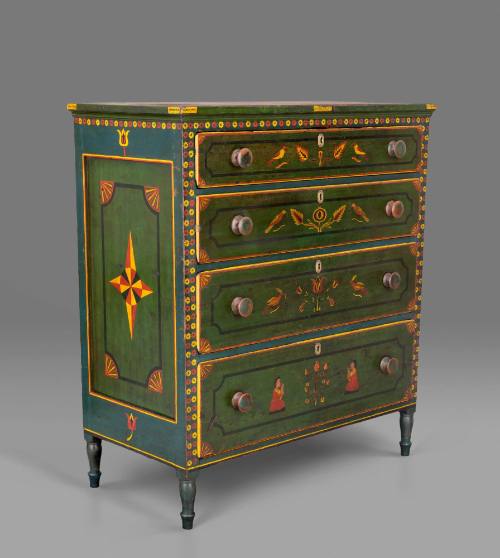
Date: 1831
I wondered if folk art disappeared in this post-modern world; the reality is that it has not, however it appears to have diminished in the United States because engagement with our own local art has. Folk art inherently has cultural connectors that people rely on for identity, community, and survival. For example, the Gee’s Bend Quilts of Gee’s Bend, Alabama were functionally important for keeping families warm in their unheated homes during the brutal winters. Materials were scarce, so quilts were fashioned out of old work clothes, flour sacks, fertilizer sacks, and cotton scraps. Yet, the quilts also have an artistic quality unique to the people and the region.
I’ll never forget the first time I saw one of these famous quilts. It was at one of the textile exhibits at the Art Museums of Colonial Williamsburg. The piece was made by quilter Rita Mae Pettway, one of several generations of quilters that once quilted in the winter by kerosene lamp.
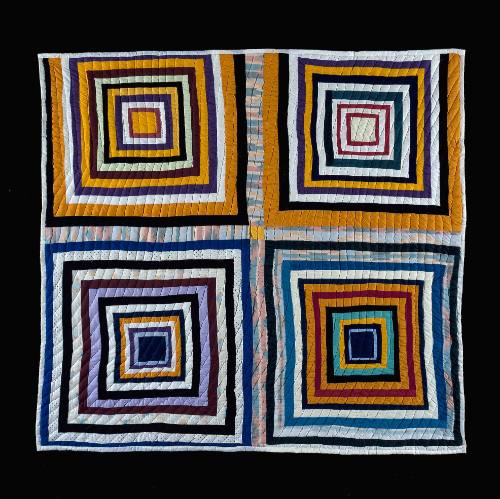
Date ca. 1990
Maker Rita Mae Pettway
After reading her small description at the museum, I was moved by her and her family’s stories and humble use of found and recycled fabrics. They became a regional sensation that caught the eyes of contemporary collectors and national admirers. Despite the Gee’s Bend residents’ success, they maintained the history of their quilts and cherish their original purpose: to keep warm and bond with family.

Whether it is classical folk art in the form of a painted dresser, the music of the Appalachian Mountains, or the colorful quilts of Gee’s Bend, looking toward the art of ordinary people keeps me grounded in reality, and helps me see the incredible potential of people.
Gray is a pretty color, but it is by far not the only color. Folk art, in all of its colors, reminds me of this.


 Cozy Crafting and Art
Leave a comment