“Two roads diverged in a yellow wood,
And sorry I could not travel both
And be one traveler, long I stood
And looked down one as far as I could
To where it bent in the undergrowth…” ― Robert Frost
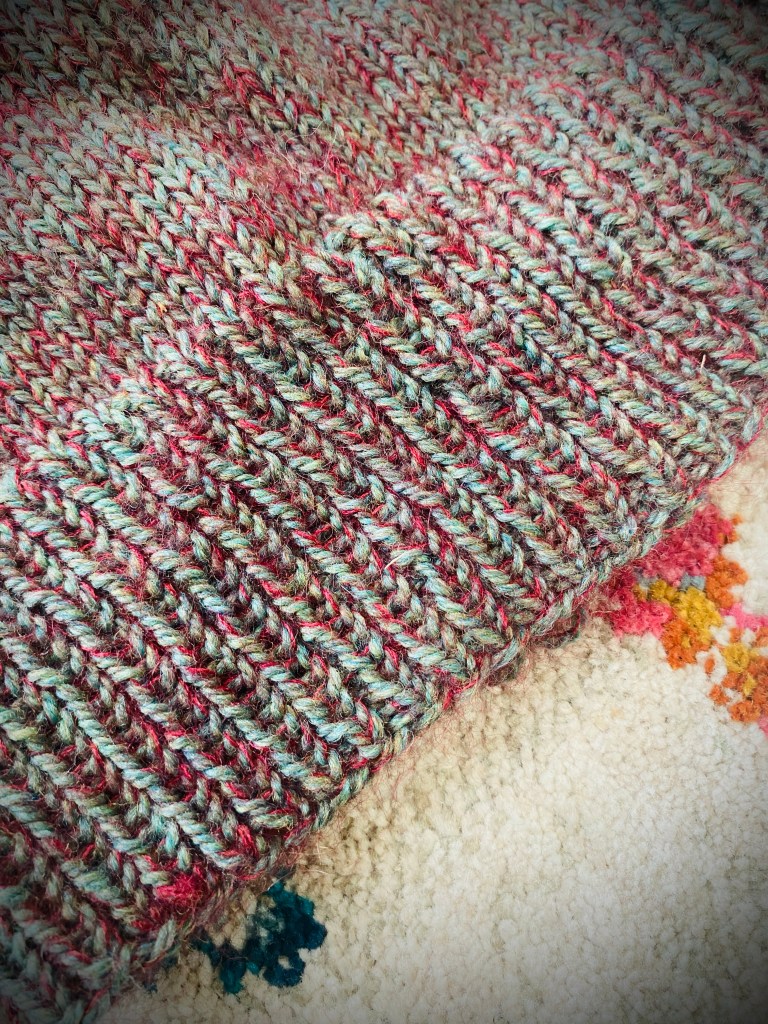
The rib stitch in knitting is a textured pattern created by alternating knit and purl stitches in a set sequence. It’s commonly used for cuffs, collars, edges, and other areas where elasticity and stretch are desired. The most common ribbing patterns are 1×1 ribbing and 2×2 ribbing.
Alternating the knit and purl stitches create vertical ridges or “ribs” on the fabric, which can not only add visual interest, but also creates a horizontal stretch, making it perfect for areas that need to fit snugly, like sleeves, cuffs, and edges.
Ribbing is also reversible, so it looks the same on both sides of the fabric.
In the example I have in the video below, I am using a Number 6 chunky weight yarn on size 10 needles. I am working on a multiple of ten stitches plus 1, meaning I have ten stitches, plus an extra stitch for symmetry.
Materials Needed for Practice
- Yarn (use a medium to bulky weight)
- Knitting needles (size 8/4mm to 13/9mm)
Holding Your Needles and Yarn
- Hold the needle with the cast-on stitches in your left hand.
- Wrap the working yarn around your right or left index finger (depending on whether or not you’re knitting English or Continental style) to control the tension.
- Hold the empty needle in your right hand.
Abbreviations
k – knit stitch
p – purl stitch
Making the 1×1 Rib Stitch
- Row 1 (Right Side): K1, P1, K1, P1, …
- Row 2 (Wrong Side): K1, P1, K1, P1, … (Repeat)
Repeat rows 1 and 2 until you have a fabric of 1×1 ribbing.
Troubleshooting
If you experience…
1. Uneven Stitches
- Problem: Your knit and purl stitches are uneven or looking different in size.
- Solution:
- Consistency in Tension: Ensure you’re knitting and purling with consistent tension. Too tight a stitch will make your ribbing look scrunched up, while too loose a stitch will cause the fabric to sag.
- Check Needle Size: If your ribbing is too tight, try going up one needle size. Conversely, if it’s too loose, switch to a smaller needle.
- Keep Stitches Even: Try to maintain even tension between your knit and purl stitches. Sometimes, it’s easy to pull the yarn too tightly on the purl stitch, causing it to shrink compared to the knit stitches.
2. Twisted Stitches
- Problem: Stitches get twisted, creating an odd look or uneven fabric.
- Solution:
- Check the Yarn Path: When you knit or purl, ensure the yarn is coming from the correct direction. If the yarn gets twisted while transitioning between knit and purl stitches, it may create twisted stitches.
- Proper Technique: Make sure you’re using the proper motion for knitting and purling. For purling, your yarn should be in front of your work, and for knitting, the yarn should be in back.
3. Ribbing Becoming Too Tight
- Problem: Your ribbing is too tight and won’t stretch properly, especially for cuffs or necklines.
- Solution:
- Use Larger Needles: If the ribbing feels too tight, try switching to a larger needle size for more elasticity.
- Loosen Your Tension: Focus on keeping your tension relaxed. Tight knitting can restrict the stretchiness of ribbing.
- Cast on Flexibly: Consider using a stretchy cast-on method, such as the long-tail cast-on or knitted cast-on, to avoid making the base of your ribbing too tight.
4. Ribbing Becoming Too Loose
- Problem: Your ribbing looks too loose and floppy, losing its structure and elasticity.
- Solution:
- Switch to Smaller Needles: If your ribbing is too loose, try going down a needle size to give the stitches more tension.
- Tighten Your Tension: Make sure you’re not knitting too loosely, especially with purl stitches, which can easily become sloppy.
- Avoid Over-Stretching: Be careful not to stretch the fabric too much as you knit. If you pull your work too tightly while knitting or purling, it will make the stitches uneven and reduce elasticity.
5. Not Getting the Correct Pattern (Knit 1, Purl 1, etc.)
- Problem: Your ribbing pattern (like 1×1, 2×2) doesn’t align, and you end up with something that doesn’t match.
- Solution:
- Double-Check Your Cast-On: Make sure that your cast-on number is divisible by the pattern (e.g., for 1×1 ribbing, you need an odd number of stitches; for 2×2 ribbing, you need a number divisible by 4).
- Check Your Row Tension: Make sure you’re not accidentally skipping or adding extra stitches. Count the stitches carefully at the beginning and end of each row to ensure you’re following the correct sequence.
6. Ribbing Looking Too Flat (Lack of Definition)
- Problem: Your ribbing doesn’t stand out or look defined.
- Solution:
- Use a Larger Needle: If the ribbing appears flat, try a larger needle size, which will give the stitches more space to pop and stand out.
- Looser Tension: If you’re knitting too tightly, the ribbing can appear more flattened. Try to relax your tension for a more defined look.
- Consider a More Structured Cast-On: Sometimes the way you cast on can affect the definition of ribbing. A looser, stretchy cast-on may help create more definition.
 Folkcrafts, Art, and Thoughts
Leave a comment