“Two roads diverged in a yellow wood,
And sorry I could not travel both
And be one traveler, long I stood
And looked down one as far as I could
To where it bent in the undergrowth…” ― Robert Frost

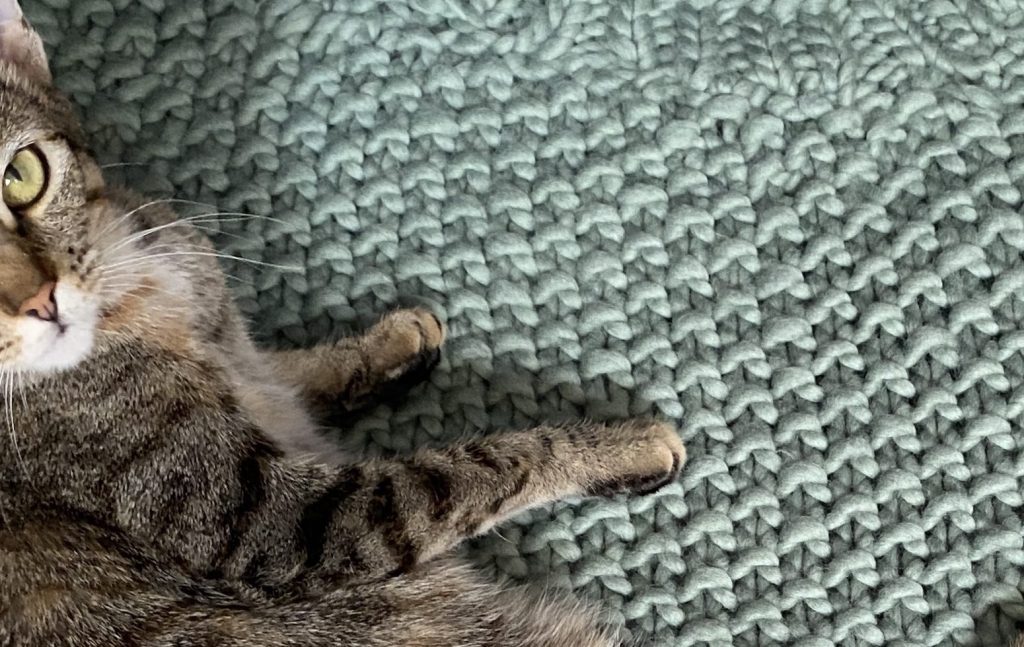
The Moss Stitch (also known as the Seed Stitch) is one of my absolute favorite stitches. It is easy enough to be a mindless stitch one can perform while watching a movie or listening to an audiobook. Yet, it also appears fancy, far outshining the Garter Stitch. All you have to do is alternate between knit and purl stitches. It creates a subtle, bumpy pattern that adds textural interest to the knit fabric. As an added bonus, it is fully reversible!
Materials Needed for Practice
- Yarn (use a medium to bulky weight)
- Knitting needles (size 8/4mm to 13/9mm)
Holding Your Needles and Yarn
- Hold the needle with the cast-on stitches in your left hand.
- Wrap the working yarn around your right or left index finger (depending on whether or not you’re knitting English or Continental style) to control the tension.
- Hold the empty needle in your right hand.
Moss Stitch Pattern
- This pattern alternates one knit stitch followed by one purl stitch across the row.
- On the next row, you repeat the sequence, ensuring that you knit the purl stitches and purl the knit stitches.
- For symmetrical work, work on a multiple of 2 + 1.
Pattern
Cast on an even number of stitches.
For example, cast on 20 stitches.
Row 1 (Right Side): K1, P1 across the row.
Row 2 (Wrong Side): P1, K1 across the row.
(This is the reverse of Row 1: Purl the first stitch, then Knit the next stitch, and continue across).
Repeat Rows 1 and 2 for the length of your project.
Moss Stitch Troubleshooting Tips
1. Uneven Stitches
- Problem: Your knit and purl stitches are uneven or looking different in size.
- Solution:
- Consistency in Tension: Ensure you’re knitting and purling with consistent tension. Too tight a stitch will make your ribbing look scrunched up, while too loose a stitch will cause the fabric to sag.
- Check Needle Size: If your ribbing is too tight, try going up one needle size. Conversely, if it’s too loose, switch to a smaller needle.
- Keep Stitches Even: Try to maintain even tension between your knit and purl stitches. Sometimes, it’s easy to pull the yarn too tightly on the purl stitch, causing it to shrink compared to the knit stitches.
2. Twisted Stitches
- Problem: Stitches get twisted, creating an odd look or uneven fabric.
- Solution:
- Check the Yarn Path: When you knit or purl, ensure the yarn is coming from the correct direction. If the yarn gets twisted while transitioning between knit and purl stitches, it may create twisted stitches.
- Proper Technique: Make sure you’re using the proper motion for knitting and purling. For purling, your yarn should be in front of your work, and for knitting, the yarn should be in back.
3. Pattern appears inconsistent
- Pay attention to your stitch orientation. The key to creating the moss stitch is ensuring that you are alternating between knit and purl stitches on each row, but always in reverse order of the previous row.
- If you want a solid pattern, continue the sequence. If you’d like the texture to stand out more, be mindful of your tension to keep the fabric uniform.
Video Tutorial
 Folkcrafts, Art, and Thoughts
Leave a comment